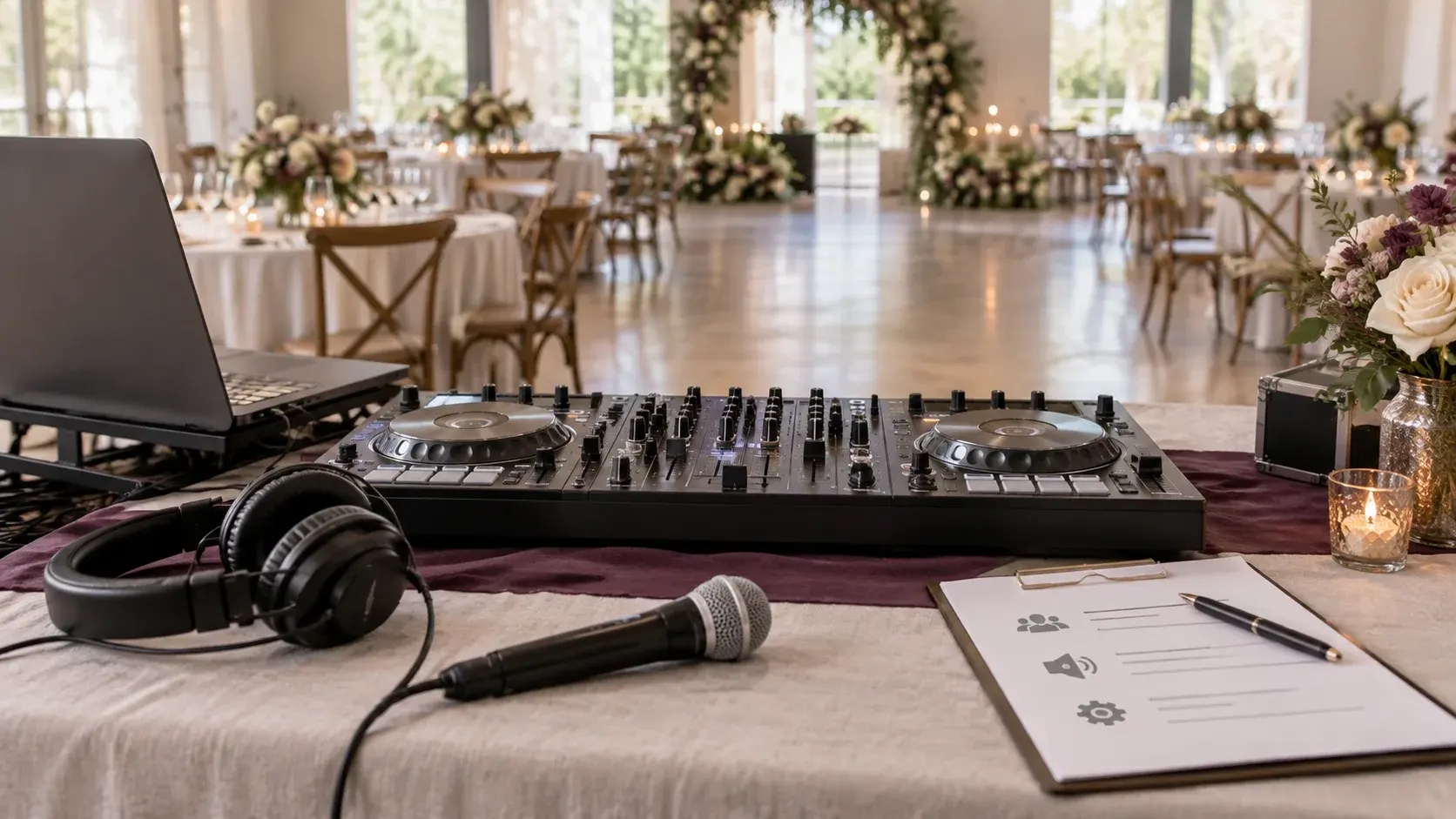
Line each quote up on the same hours, ceremony sound, rooms, equipment, travel, and added charges. A lower package price can leave more of that work outside the total.
Compare the quote
Compare the same work in every DJ quote.
Check hours, rooms, equipment, ceremony audio, travel, setup, teardown, and overtime before you compare totals.
Use the wedding DJ cost benchmark carefully
The Knot’s 2026 report surveyed 10,474 U.S. couples married in 2025, recruited from The Knot or WeddingWire membership. That count is the full study sample. The number of couples who answered the DJ question is a separate figure. Its DJ row does not define a standard package or a local price.
Start your shortlist with your own event details. Write down the ceremony time, reception end time, rooms, and sound needs. Ask each DJ to price that same plan. Then you can see whether a higher price buys work you need, optional extras, or a different level of service.
Match hours, rooms, and equipment before comparing prices
A package name doesn’t show everything it covers. Read the start and end times, then check each place where guests need music or announcements. Ask the DJ: “Are planning, setup, sound checks, and removal inside the quoted hours?”
- Coverage:
record ceremony, cocktail hour, dinner, dancing, and the final announcement. Ask which start and end times the price covers.
- Locations:
list separate ceremony, cocktail, and reception spaces. Ask how the DJ will cover a move between rooms or an outdoor ceremony.
- Equipment:
list speakers, microphones, ceremony sound, and lighting. Mark each item as included, added, optional, or still needing confirmation.
- People and preparation:
confirm the named performer, emcee duties, planning meetings, setup access, and the backup plan.
Spectrum Sound lists a $2,100 package with up to seven hours, ceremony coverage, and a separate cocktail-area system. Its $1,550 reception package describes five-to-six-hour coverage, so confirm the exact hours before comparing the two. We checked these offers from one provider on September 11, 2026, so they describe that company’s packages only.
Build a known subtotal and keep open costs visible
For each proposal, add the package price and only the required items it leaves out. Keep optional extras on their own line until you choose them. A service the package already includes goes on the checklist once and adds nothing to the subtotal.
Pro Sound & Light Show’s menu lists a $1,200 base for up to four hours on select dates, $425 ceremony coverage, and $200 per additional hour. Those menu prices do not show that an extra applies to a different package. Confirm date eligibility, included services, and travel before you use a total.
Ask each provider to fill in the same item list: “Could you complete every line, including the items with no charge?” A blank line means you still need an answer. Enter zero only when the provider confirms the item is included or has no charge.
Compare an on-time event and one extra hour
Example numbers: these are made up for illustration and don’t come from any provider offer or market estimate. Assume both quotes cover the same six-hour event and ceremony equipment, and that each extra-time rate is confirmed, available, and billed by the full hour. Fees and tax are still open in both quotes.
- Example A:
$1,200 covers four hours. Add two hours at $175 each, $300 for ceremony sound, and $100 travel. Calculated known subtotal: $1,200 + $350 + $300 + $100 = $1,950.
- Example B:
$1,850 covers the same six hours, ceremony sound, and travel. Calculated known subtotal: $1,850. The on-time difference is $100 before the open charges.
Now say the reception runs one full hour longer. Example A adds $175, for a calculated known subtotal of $2,125. Example B adds $250, for $2,100. The difference shrinks to $25, and final fees or tax could still change which quote costs less.
The second calculation helps you choose between buying enough coverage now and paying a confirmed extra-time charge later. Run it again with the timeline you expect. Then ask the DJ: “If we run over, do you round a partial hour up, and who can approve the extra time on the day?”
Get the overtime rule in writing
Spectrum Sound’s package note gives $250 per extra hour for packages 01 to 03. Its general menu shows $150 per half hour or $300 per hour. Ask which rule applies to the package you choose. Until you know, write both rates down and mark the overtime line still open.
Pro Sound & Light Show’s menu also lists a $475 overtime fee beyond eight hours, with no clear unit. Mark the unit as still open until the company confirms it. That wording alone does not establish a $475 hourly rate.
- When does overtime start:
after the performance period, at a fixed clock time, or after another agreed event?
- What is the unit and rounding rule:
per hour, per half hour, or one added fee?
Can the DJ stay late, and would venue access, staffing, or other vendors add separate charges?
Turn two package quotes into one event plan
Give each DJ a copy of the same timeline before you compare the packages. Start at the first moment guests need sound, then end at the last announcement or song.
Add a separate note for access and setup, because those times may sit outside performance hours. If a quote says only “reception,” ask whether ceremony microphones and cocktail music are included. A package name cannot answer that question for your event.
Make a comparison sheet with one column for each provider. Put the promised hours, rooms, equipment, performer, travel, and payment dates in the same row on both sides. Mark a line “included,” “priced extra,” or “still open.”
Do not enter zero for an open line. Once both providers answer, add only confirmed required extras to each package price. Keep optional lighting or additional coverage outside the total until you choose it.
The example above changes the order of the quotes when the event runs long. Use that result as a question about your own schedule, not as a prediction that overtime will occur.
If your venue closes at a fixed time, ask whether the DJ can actually provide an added hour. If the answer is no, an overtime rate has no value in this comparison. If the answer is yes, record the approval rule and any venue cost alongside the DJ charge.
Resolve the gaps in each proposal
Share the completed sheet with the person who will pay the deposit. You might say, “The first quote covers our ceremony and reception, but its travel line is still open. Can we wait for that answer before choosing a deposit?” That makes the remaining decision clear without turning a provisional subtotal into a final price.
Also ask what happens when the named performer cannot attend. Put the substitute performer, notice method, and your choices in the written agreement. If your ceremony and reception are in different spaces, ask who moves the equipment and whether there is a sound gap during that move.
That answer may change the timeline you send to the photographer and venue. Do not assume a second sound system is included because one provider's package lists it.
Finally, compare payment dates as well as totals. Record the amount due to reserve the date, the later balance, and any charge for a change in hours or rooms.
When a deposit is credited toward the package price, show it as a payment within that total. Ask for a revised proposal when your timeline changes. The revised scope gives your partner, the DJ, and the person paying one current version to use.
At the last comparison, ask each provider to point to the one part of your schedule its package does not cover. That may be a room, a microphone, setup access, or a late finish.
Put the answer in the matching row and decide whether you need that service. You can remove an optional extra from both quotes, but you should not remove a required service from only one. When the two scopes match, the price difference has a clear meaning.
Confirm scope and payment dates before booking
Send both providers your event timeline and one shared checklist, and ask for a dated written reply. Keep the proposals, signed agreement, invoices, and messages together in one folder. The FTC recommends retaining original purchase documents and records of conversations, dates, and promises.
Which exact hours, locations, sound systems, microphones, and lighting does this price include?
What required charges remain outside it, and what event detail determines each amount?
What does one extra hour cost, who approves it, and is that extension available?
What is due now and later, and how do date changes, cancellation, or performer substitution work under this agreement?
Your next step
Compare the answers before you choose the lower price. If a term stays unclear, ask for a written correction. Then use the payment-schedule guide to put the confirmed deposit and balance on your calendar.
Frequently asked questions
Does a DJ package include ceremony sound?
That depends on the package, so check it line by line. Spectrum Sound, for example, separates reception coverage from packages that include ceremony equipment, so read the package description and your written proposal. When a package already includes the ceremony system, it should carry no second charge for the same work.
Is the cost per hour the DJ’s hourly wage?
No. Dividing a package price by performance hours gives you a number for comparing quotes, and the package may also cover equipment and other work. Compare the included services before you use that number to judge value.
Can I count an unlisted travel fee as zero?
Not until the provider confirms it. Mark travel as still open and ask: “Is travel included for our venue address?” Enter zero only after the provider confirms that the offer you chose has no travel charge.
Should I choose the cheapest DJ quote?
Only after you compare the same event coverage and confirm every required charge. Then weigh the performer, equipment, backup plan, and terms you need. While important costs or services are still open, a lower known subtotal leaves the choice unsettled.
Last reviewed . Editorial standards