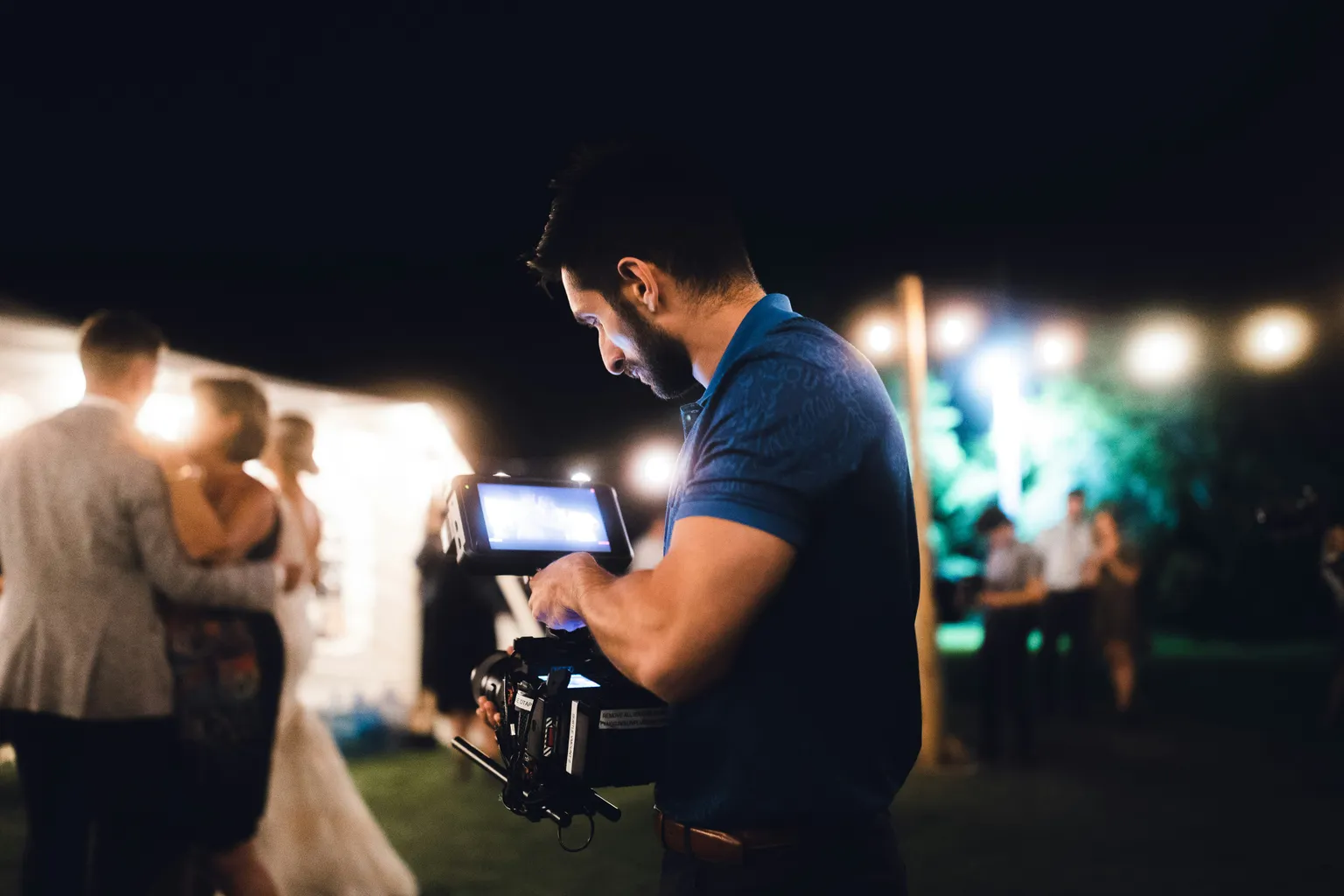
Zola puts videography at about 8% of a wedding budget and says overtime typically runs $200 to $400 an hour. Compare quotes for the same day length and finished videos.
How much does a wedding videographer cost?
Two national sources answer this, and their numbers sit far apart. WeddingWire puts the average at $1,799, based on prices couples reported in their reviews. Zola's Wedding Cost Index, last updated March 4, 2026, puts it at $3,993.
| Source | Average | Most couples | Low and high end | How it's measured |
|---|---|---|---|---|
| WeddingWire cost guide | $1,799 | $1,000 to $2,500 | $500 or less at the low end, $3,900 or more at the high end | Spend reported by thousands of couples in their WeddingWire reviews |
| Zola Wedding Cost Index | $3,993 | $3,200 to $4,800 | No national low or high end; Zola publishes city averages for 150-guest weddings instead | Zola's index of national and regional spending on its platform, plus a 2026 couple survey |
The two typical ranges never touch. WeddingWire's stops at $2,500, and Zola's starts at $3,200. Neither source explains the gap, and each one measures a different group of couples in a different way. Zola is also the only source we found for the 8% budget share and the overtime rate used below.
So treat the pair as the two edges of a planning range, from $1,000 up to $4,800. Write both averages on the video line with their source names beside them. Both describe couples across the country, so only a written quote gives your own price.
What is a good budget for a wedding videographer?
Zola's index puts videography at about 8% of the total wedding budget. That share is a starting envelope. Check it against both typical ranges before you settle on a number.
- $20,000 wedding:
8% is $1,600, inside WeddingWire's typical range and below Zola's.
- $30,000 wedding:
8% is $2,400, near the top of WeddingWire's range and $800 under the start of Zola's.
- $45,000 wedding:
8% is $3,600, above WeddingWire's typical range and inside Zola's typical range.
If the envelope lands below the quotes you get, you have three choices. Move money from another line, cut coverage hours, or pick a lighter package. Decide together which other line can give.
What changes a wedding videography quote
| What changes | How it moves the price | Question to ask |
|---|---|---|
| Coverage hours | More filming time costs more. WeddingWire notes a four-hour package costs less than a 12-hour one, and Zola lists overtime at $200 to $400 an hour. | "What is your overtime rate?" |
| Team size | A second shooter or assistant raises the price. Zola says a solo videographer costs less but films fewer angles at once. | "How many people film, and during which hours?" |
| Finished videos | Most videographers deliver a highlight reel and an edited film. Raw footage and short social clips can add to the cost. | "Which videos are included, and how long is each?" |
| Extras | About 43 percent of videographers offer drone footage, Super 8 film, or extra drives at added cost, according to WeddingWire. | "Which extras are in this price?" |
| Travel | A long trip can add mileage, airfare, and a hotel. Zola says some videographers include travel within a set radius. | "How far can you travel before a fee applies?" |
WeddingWire says a package pays for the filming hours, the editing, and the equipment, and that price varies with the videographer's experience. For the labor alone, the Bureau of Labor Statistics lists 2025 median pay of $36.10 an hour, or $75,100 a year, for film and video editors and camera operators, against $50,980 for all workers.
Calculated from that median, 9 hours of filming comes to $324.90 in wages, before any editing. BLS pay also varies widely: the lowest 10% of camera operators earned under $38,520 and the highest 10% over $135,180, and its wage data leave out self-employed workers, who hold 35% of these jobs. That $324.90 covers time on site only, so judge each package price against the other quotes you collect.
Two video quotes, priced per coverage hour
Two quotes can look $1,800 apart and end up $1,200 apart once both cover the same day. Example numbers: Quote A is $2,400 for 6 hours, one videographer, and a highlight film. Quote B is $4,200 for 8 hours, two videographers, and a highlight film plus a longer edit.
Your day needs 9 hours, and both charge $300 per overtime hour, inside the $200 to $400 an hour Zola says overtime typically runs.
| Line | Quote A | Quote B |
|---|---|---|
| Package price | $2,400 for 6 hours | $4,200 for 8 hours |
| Calculated price per quoted hour | $400 | $525 |
| Overtime to reach 9 hours | 3 hours times $300 is $900 | 1 hour times $300 is $300 |
| Calculated total for 9 hours | $3,300 | $4,500 |
| Calculated cost per coverage hour | $366.67 | $500 |
| Team and edits | One videographer, highlight film | Two videographers, highlight film and a longer edit |
At the same 9 hours, the $1,200 gap buys a second videographer and a second finished video. Travel, raw footage, and a drone are not listed yet in either quote, so they stay outside both totals.
Check the math: $2,400 plus $900 is $3,300, and $4,200 plus $300 is $4,500. Then ask each videographer: "If our reception runs an hour late, what is the charge, and who decides to stay?" Get it in writing.
Wedding video packages side by side
Zola sorts wedding videography into basic, standard, and premium tiers by hours and team, and gives no price for each tier. Both Zola and WeddingWire mention ceremony-only coverage, and WeddingWire adds raw footage without the edit. Zola also describes a content creator, who sends quick raw clips, as an alternative or an addition to a videographer.
| Option | Coverage and team | What you receive | Price to plan with |
|---|---|---|---|
| Content creator | Behind-the-scenes moments, one creator with a smartphone and gimbal | Raw, unedited files within 24 hours | $500 to $999 for most couples in Zola's survey |
| Ceremony only | The ceremony | Ceremony footage | Fewer hours cost less, per WeddingWire, so ask for it priced on its own |
| Raw footage only | The hours you agree on | Unedited files, no finished film | Can cost less, since WeddingWire calls editing the costliest part |
| Basic package | 4 to 6 hours, one videographer | A highlight reel | Zola gives no tier price; check quotes against the national ranges above |
| Standard package | 6 to 8 hours, one or two videographers | Highlight reel and a longer documentary edit; drone often offered | A second shooter and drone add cost, per WeddingWire |
| Premium package | 8 to 12 hours, multiple videographers | Several edits, raw footage access, cinematic editing | More hours and people raise the price; compare per coverage hour |
Ask each videographer: "Which of these options do you offer, and which files do we keep from each?" Write each answer next to its row.
Is it worth hiring a videographer for a wedding?
It is worth it when a quote for your must-have moments fits the envelope you can comfortably afford. Zola points out that video keeps sound and movement, such as vows and speeches, that photos miss. Use this rule, built from Zola's 8% share and the two typical ranges in the first table.
If 8% of your budget is under $1,000 (a total under $12,500), your envelope sits below both typical ranges. Price a content creator, ceremony-only filming, or raw footage first.
If 8% lands between $1,000 and $3,200 (a total from $12,500 to $40,000), you are inside WeddingWire's range or in the gap between the two. Price a single videographer for your core hours, then ask what one added hour costs.
If 8% is $3,200 or more (a total of $40,000 or more), Zola's typical range fits. Compare team size and edit length on the same hours.
Some families would rather put the money toward the photographer, and some want the voices on record. Ask your partner: "If we could keep one recording from the day, whose voice would it be?" Price that part of the day first.
What to check in the videography contract
| Contract line | What the source says | Question to ask |
|---|---|---|
| Footage rights | The U.S. Copyright Office says the creator is ordinarily the author. A commissioned part of an audiovisual work is made for hire only under a written agreement, signed by both sides, that says so. | "What can we do with our films, and who owns the footage?" |
| Files | For keeping video long term, the Library of Congress prefers the final file at its original resolution and frame rate, and treats an .mp4 as a viewing copy. | "Which files do we receive, at what resolution, and for how long?" |
| Drone | Under 14 CFR 107.12, the person flying a small drone needs a remote pilot certificate with a small UAS rating, or direct supervision by a certified remote pilot in command who can immediately take direct control of the flight. | "Who flies the drone, and may we see the certificate?" |
| Edits and delivery | WeddingWire says a videographer may allow one round of changes, and more can cost extra. | "What is the delivery date, and how many rounds of changes are included?" |
| Tip and timing | WeddingWire suggests a $100 to $200 tip and hiring at least eight months ahead. | "Is any gratuity already in this price?" |
For copyright terms, ask an attorney. Keep the tip on its own line, outside the contract total, and get every answer in writing.
Compare the quote
Add the same video total to every venue quote.
Price each videographer for the same day length, finished videos, and overtime. Then add that total to Other required costs in each venue quote you compare.
Frequently asked questions
How much should you pay for a wedding videographer?
The national averages are $1,799 in WeddingWire's couple-reported prices and $3,993 in Zola's Wedding Cost Index. To find your spot in that span, price the coverage your day needs: Zola's basic tier covers 4 to 6 hours with one videographer, and its premium tier runs 8 to 12 hours with multiple videographers.
How much should you spend on a wedding videographer?
Most couples spend $1,000 to $2,500 by WeddingWire's data or $3,200 to $4,800 by Zola's, the two ranges compared in the first table. On top of the package, plan for overtime and a tip, which WeddingWire suggests at $100 to $200. Keep the tip on its own line.
How much does a video cost for a wedding?
A wedding video can cost $500 or less or $3,900 or more, the low and high ends of what couples reported to WeddingWire. WeddingWire says time, staffing, the finished videos, extras such as drone footage, and travel move the price. Ask for each of those as its own line.
How much should a videographer charge per video?
The closest per-product price we found is Zola's $500 to $999 for a content creator's raw clips. None of the sources we checked lists a per-video rate for an edited wedding film, since videographers price packages by hours and team. Divide each quote by its coverage hours, and ask what each extra video adds.
What is a reasonable budget for videography?
Zola's index puts videography at about 8% of the total wedding budget, which is $2,000 on a $25,000 wedding. Hold a cushion on top for overtime, which Zola says typically runs $200 to $400 an hour. Ask each videographer for the rate in writing, and set aside at least one hour of it.
Last reviewed . Editorial standards