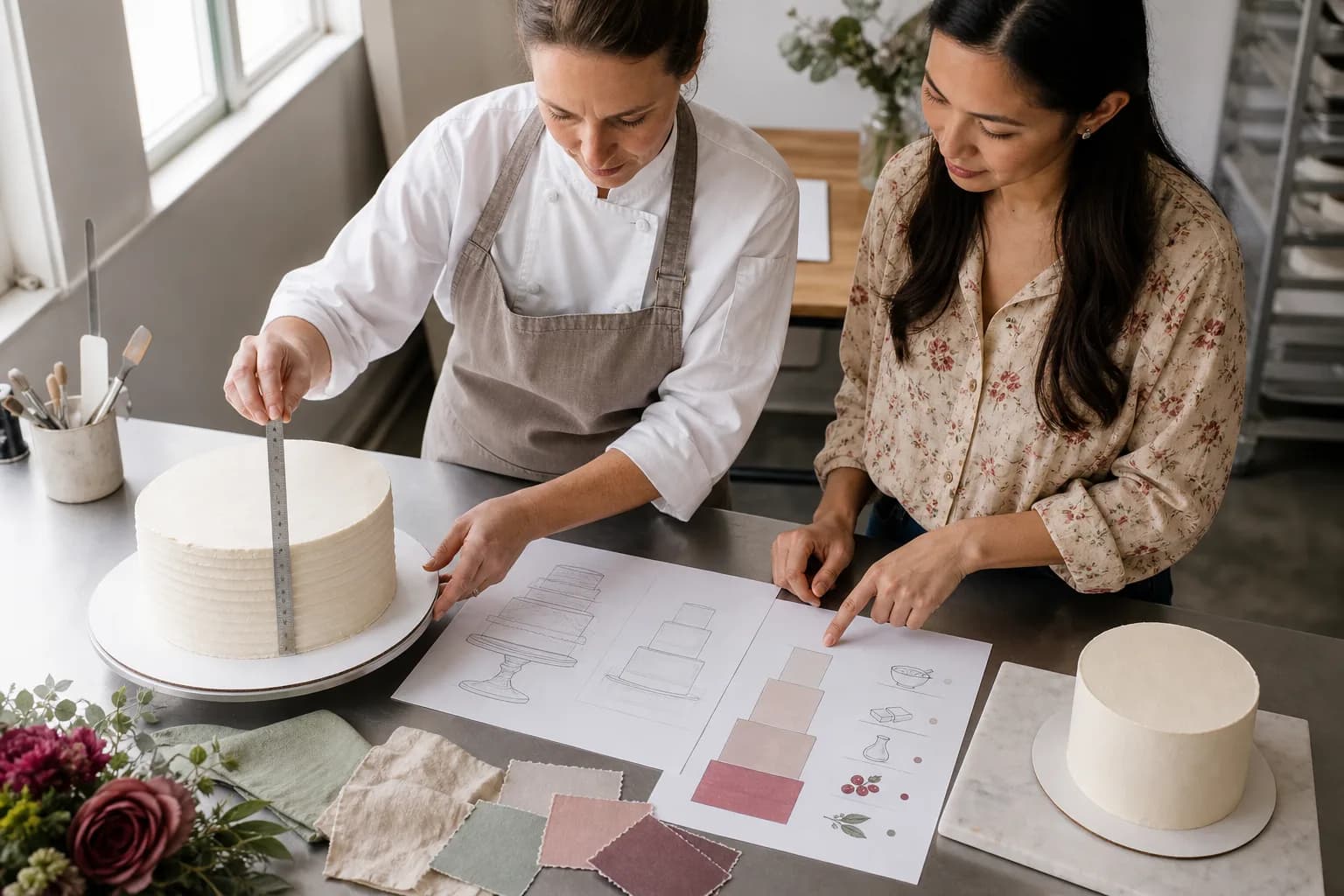
Your wedding cake cost is required servings times the bakery rate, plus design and flavor charges, tasting, delivery and setup, rentals, venue cutting or plating, and any taxes or service charges that apply.
How to read a wedding cake cost benchmark
Keep the two national figures on separate lines. The Knot's current PDF table reports $530 in the Cake row, with $300, $500 and $800 shown for its low, medium and high spend bands. Its broader methodology says the study captured responses from 10,474 U.S. couples married during 2025 who were recruited from The Knot or WeddingWire membership.
The report also says some statistics come from separately fielded ad hoc studies. The PDF doesn't identify the Cake row's exact denominator or standard inclusions. Zola's cake guide reports a $917 national average and a $700 to $1,100 typical range, and that page doesn't show a cake-specific sample size or a calculation you can repeat.
Both figures are single-publisher findings, so they can't be swapped for each other or read as one national market price.
It's tempting to average $530 and $917 into one number. The cited pages don't provide matching cake-category definitions, samples or reproducible raw data, so that calculation wouldn't hold up.
The figures may reflect different couples, products, locations and inclusion rules. Use both as broad context, note in your budget that they disagree, and let current proposals from bakeries serving your date and location decide. Neither benchmark is a recommended budget, a local expectation or a promise that a particular design can be bought for that amount.
You might tell your partner: “Let's keep both numbers in mind and let the bakery quotes set our cake line.”
Start with servings before choosing cake tiers
Begin with expected attendance instead of invitations sent, and decide what role cake plays. Is it the only plated dessert, one option on a dessert table, or a small ceremonial cake? Then ask the baker and caterer to use the same serving definition and cutting plan: “Are you both working from the same slice size and cutting plan?”
Wilton's test-kitchen chart bases wedding servings on slices measuring about 1 by 2 inches, and it explicitly calls the yield a guide and says actual results may vary. Use the chart to frame your questions, and let your baker's cake height, shape, construction and contracted yield set the real count.
Calculate required servings as expected attendees times the cake-take rate you choose, plus any planned leftover servings, rounded up. The cake-take rate is your own planning assumption. If the top tier will be boxed or saved, subtract its yield from the servings available to guests.
If another dessert is offered, decide whether guests may take both, and only then adjust the cake order. Run a low, working and high attendance case, so a late head-count change doesn't force a rushed tier decision. Write the assumption beside each result, and look at it again when the caterer's final count is due.
Build an all-in wedding cake cost model
Use one equation for every proposal. All-in nonrefundable cost equals display cake plus supplemental cake plus design and flavor add-ons, plus any tasting not credited, delivery and setup, rental fees, venue cutting or plating, and the taxes or service charges that actually apply.
Calculate display cake as display servings times its rate, and supplemental cake the same way. Calculate venue service only from the contract's stated basis, which might be guaranteed guests, attendees, servings, slices or a flat charge. Apply a percentage to a subtotal only when the proposal names that charge and its base.
Expected attendees, planned cake-take rate, planned leftovers, required servings and whether the reserved top tier is excluded from service.
Display and supplemental servings, each rate, minimum order, serving dimensions, flavors, fillings, design labor and tasting credit conditions.
Delivery, setup, access limits, stand or equipment rental, venue cake service, taxes, service charges and card charges as separate rows.
Refundable deposits and return deadlines, kept outside the permanent-cost subtotal even when that cash is due before the wedding.
Price the design, delivery, rentals and venue service
Servings are only the first thing that moves the price. Zola's cake guide points to size, design, location, flavor, ingredients, the baker's time and artistic work.
Turn each of those into an item the bakery can confirm: contracted servings, tier structure, frosting, filling, tier flavors, handmade decoration, fresh-flower responsibility, dietary formulation, delivery distance and setup work. Then ask: “Which of these are in the base rate, which are flat additions, and which are charged per serving?” A pretty sketch without those pricing rules can't be compared with another quote yet.
Local menus show why a starting rate needs its conditions attached. Gâteau Bakery in Northern Virginia currently lists custom buttercream designs starting at $12 per serving, fondant at $13, and a $450 minimum. Its separate supplemental product is $7 per serving with a 38-serving minimum.
Classic Bakery's DC and Baltimore-area guide lists a $7-per-serving starting point only for cakes of at least 75 servings, and says decoration, labor, material and complexity can raise the price. Both are current local examples. Read them for the rules inside a quote, and don't use them to negotiate with a bakery in another market.
A delicate tiered cake needs timed access and assembly, so delivery covers more than mileage. Confirm the destination, arrival window, load-in route, stairs, refrigeration or holding needs, setup responsibility and handoff point. Gâteau says delivery is available for cake orders meeting its $400 minimum and lists a $55 minimum delivery rate.
Classic Bakery lists a $100 minimum for tiered-cake delivery, calculated by mileage. Classic also lists a $25 stand rental and a separate $200 refundable security deposit, with the stand due back cleaned and undamaged within three days. Those local policies show why delivery cost, rental cost and refundable cash each need their own row.
Venue service varies just as much. Texas A&M Hotel and Conference Center currently says outside cake is allowed without a bringing-in fee, but lists a $2-per-person cake-cutting charge.
Branches Events in New Jersey says cake cutting, setup and breakdown are included in its broader per-person offering. Neither policy establishes a national cutting-fee range, and an included service can still carry a cost inside the package price. Ask what your charge covers: cutting only, or also plating, serving, plates, forks, garnish, packaging leftovers and handling the top tier.
Then confirm whether its basis is guests, slices, servings or a flat amount.
Compare a display cake with a cutting-cake plan
Example numbers: a made-up wedding with 125 expected attendees, another dessert available and a planned 100 cake servings. Quote A uses 100 display servings at an assumed $10 each, plus $150 of design labor, $75 delivery, a $25 stand rental and venue service at an assumed $2 for each of 125 attendees. Calculated pre-tax nonrefundable total: $1,500, which is 100 times $10, plus $150, $75, $25 and $250.
We invented these rates only to show the calculation.
Quote B uses a 36-serving display cake at the same assumed $10 rate and 64 supplemental servings at an assumed $5 rate, with the same $150 design amount, $75 delivery, $25 rental and $250 venue service. Calculated pre-tax total: $1,180, or $320 less under only those assumptions.
Check the savings with a break-even rule: potential savings equals supplemental servings times the difference between display and supplemental rates, minus any new handling, setup, delivery or service costs. If the extra costs exceed the cake-price difference, the smaller display cake doesn't save money.
Use a cake checklist while you compare bakeries
Before choosing, ask each finalist to revise the proposal for the same date, address, expected attendance, required servings, design brief and service plan. Then ask them to fill every open line: “Could you give each blank line a price, a clear exclusion, or a decision deadline?”
Compare the nonrefundable total, cash due, cost per required serving and costs still open. Some uncertainty can stay open. Just keep one quote from looking cheaper because the stand, delivery, venue service or extra servings are still missing.
Confirm serving dimensions, contracted yield, cutting diagram, top-tier treatment, exact flavors and fillings, design elements, colors and who supplies or places fresh flowers.
Write down tasting cost and credit conditions, deposit amount, balance dates, change and cancellation deadlines, rental return condition and refund timing. Classic Bakery's published three-day stand-return policy is one local reminder that these deadlines can be specific.
For an allergy request, name the specific allergen and ask the bakery to describe ingredients, substitutions and its own cross-contact procedures, instead of treating a flavor label as a safety guarantee. FDA says food allergies can be life-threatening and identifies eight foods under FALCPA plus sesame as the ninth major food allergen.
Its page doesn't certify a custom bakery or the cake you're considering.
Plan who receives the cake after setup, who cuts and boxes it, what happens to leftovers and which baker-approved storage instructions apply to the actual cake, filling and frosting.
Save the signed quote, contract, invoices, receipts and key communications. The Federal Trade Commission's general consumer guidance recommends gathering those records and keeping originals when working through a business problem, and it doesn't promise a particular refund or remedy.
Compare the quote
Compare servings and service in every cake quote.
Check servings, design work, delivery, setup, rentals, cutting fees, and changes before you compare cake quotes.
Frequently asked questions
How much wedding cake do I need for 100 guests?
Don't automatically order 100 servings. Start with expected attendance, decide whether cake is the only dessert, and choose a cake-take and leftover assumption. Confirm the baker's contracted serving dimensions, cutting plan and whether the top tier will be served. Run the same assumptions through every quote, because tier count alone is too little to go on.
Is a wedding cake priced per slice or per tier?
Either structure may appear in a proposal. Even when a baker quotes a per-serving starting rate, minimums, design labor and complexity can override simple multiplication. Ask for the contracted serving yield, each rate and add-on, and the all-in total. Don't compare a tier count with a serving count as if they were the same unit.
Does a sheet cake for a wedding save money?
It can, but only when the lower supplemental-cake price saves more than any added delivery, handling, setup or venue-service costs. Compare options with the same required servings, flavor and service plan. Treat 'sheet cake' as a product label to check, since the name alone doesn't prove its height, filling, presentation or per-serving price matches the display cake.
What is a wedding cake cutting fee?
A cutting fee is a venue or caterer charge that may cover some combination of cutting, plating and serving, and its basis and inclusions vary. Texas A&M Hotel lists a per-person charge, while Branches says cake cutting is included in its broader package. Read your proposal for the unit, the exact services and whether an outside or supplemental cake changes the charge.
How should we handle leftover wedding cake?
Decide before the reception who will box the leftovers and the reserved top tier. Ask the baker in writing how and when the actual cake, filling and frosting should be chilled or frozen, and confirm who can move it into storage after service. Don't copy one generic storage time onto every recipe. If instructions are missing, ask the baker before anyone serves the leftovers.
Last reviewed . Editorial standards