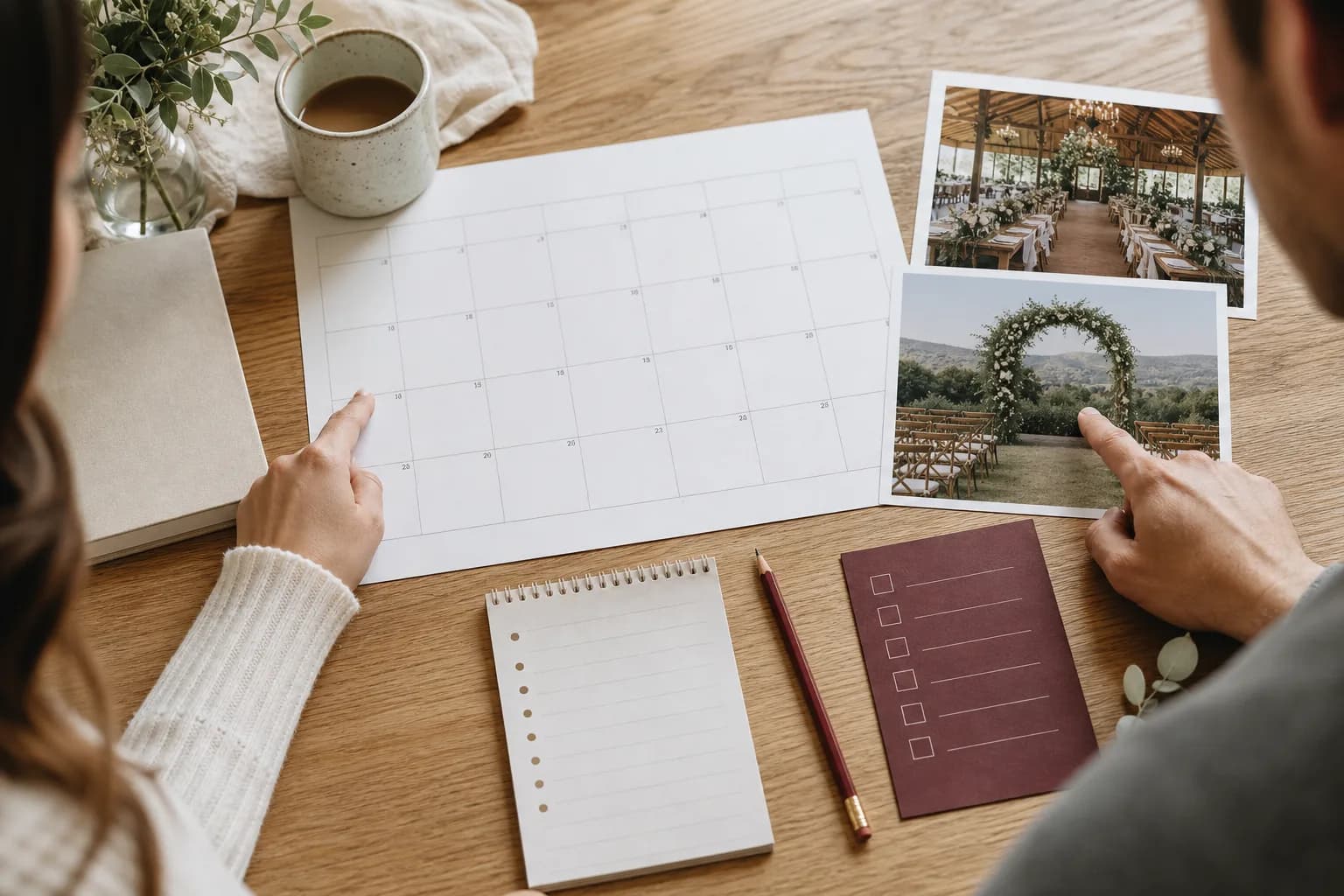
The public examples we checked open on a fixed 11-month, one-year, or annual schedule. Start researching once you know your location, rough guest count, comfortable budget range, and acceptable dates. Book only when the calendar is open, the date and capacity are confirmed in writing, the all-in cost and contract make sense, and the deposit is affordable.
Why there is no universal wedding venue booking deadline
Three dates often get blended into one: when a couple starts planning, when a venue opens its calendar, and when a particular date is taken. New York State Parks says most event rentals can be reserved exactly 11 months ahead, while Long Island sites in the same system open each year on February 1. Portland used its own annual procedure for April to December 2026 wedding dates.
In-person reservations opened January 5, phone, online, and mail requests opened January 6, and requests made fewer than 45 days ahead could incur rush fees. You can research earlier, but you can't complete a reservation before the release. A ceremony on public land adds a step, because an application still needs approval.
Rocky Mountain National Park accepts applications one year ahead of the desired wedding month and reviews them first-come. It also says ceremonies may be scheduled as late as seven days before the date, though it doesn't guarantee a last-minute request. Its locations stay public, and permit limits apply.
These are local, dated rules, so ask each venue: “What is this venue's exact release rule for my event date, and what remains conditional after I apply?”
Use four clocks to decide when you should book
You're ready to book when four clocks line up. Write down each fixed requirement, with the proof beside it. A narrow plan adds urgency, and a flexible plan opens more paths. Still, moving fast on demand can't open a closed calendar or make a contract affordable.
- Demand clock:
urgency rises as more requirements become fixed, such as one date, one day of the week, one season, one location, a large guest count, or a specialized space. Skip national peak-season labels and ask each shortlisted venue: “Which of our dates and setups are actually hard to get?”
- Release clock:
write down the exact date and time your month opens, how requests are handled, whether a hold expires, and whether a separate permit follows. The public examples we checked include rolling 11- or 12-month windows, annual opening days, and first-come review. “Earlier” means little until you know which system applies.
- Readiness clock:
once a venue offers the date, set a working total-budget ceiling, guest-count range, date range, and the person who pays. Get an itemized proposal and review the contract. The Ohio Attorney General warns about fake or unavailable venue ads and vague contracts.
It advises research, an in-person meeting where possible, secure payment, and itemized services and costs.
- Logistics clock:
list destination travel, lodging, public access, permits, weather fallback, accessibility, and dependent vendors before committing. Read each site's operating terms as part of the decision, while you still have time to act on them.
How far in advance should you book a wedding venue by scenario?
- One exact Saturday or one specific private venue:
treat 12 to 18 months only as a cautious checkpoint for inquiries, drawn from local examples. Venue at the Stables reports that its own couples book 6 to 18 months ahead and that it hosts one wedding per weekend.
Chatsworth says its own couples often book 12 to 18 months ahead and that its spring and fall weekends fill fastest. 314 Exchange reports an 11 to 14-month pattern for its own bookings. Each venue reports on itself, so ask your target venue: “Which of our dates are still open right now?”
- Several dates, weekdays, or off-peak periods:
the sources we checked don't establish a national lead time for this plan. Start inquiries once your budget, count, and date range are usable. Then compare cost, capacity, weather plan, and terms. One Kentucky venue, 314 Exchange, says most of its couples secure dates 11 to 14 months ahead.
It also says it occasionally has Fridays, Sundays, and off-peak dates available within a few months. That possibility is specific to one venue.
- Public park or municipal space:
research the rules well before opening day, then apply under the published procedure. Confirm whether the reservation and wedding permit are separate, whether approval is first-come or reviewed another way, what use stays public, and when final confirmation arrives. Keep a second site and an indoor or weather backup until the date is truly secured.
- More than two years away:
research now, and don't assume paying now is accepted or helpful. Zola says some members of its 2026 engaged-couple sample started planning before the proposal, and its reported average engagement was 18 months. Neither figure measures how far ahead couples book venues. Use the extra time to refine the budget and count.
Track each venue's opening date, pricing status, and change terms for far-off dates.
- Six months or less:
a short runway can still work. Inquire now and run several searches side by side. Offer multiple dates, including Friday, Sunday, or weekday options, and ask about cancellations. Consider restaurants, hotel rooms, community spaces, or a smaller format, and keep the full cost and contract review in place.
Couple B is six months out, would take three Sundays in two nearby towns, and has a smaller guest range. They contact eight spaces with the same scope, compare available dates and real totals, and can book once one written offer clears the readiness and logistics checks.
Couple A starts earlier because the plan is rigid, and Couple B may book sooner because the plan is flexible. Neither timeline proves availability. Neither couple should pay while a major cost, capacity, or contract term is still open.
What to confirm while you compare venues
Start with a written scope. Confirm usable ceremony, reception, and bad-weather capacities for your layout. Then list access, event, rehearsal, and teardown hours, plus food-and-beverage minimums, service charges, tax, staffing, rentals, security, insurance, cleanup, overtime, and any required lodging.
Read the payment, cancellation, postponement, venue-cancellation, substitution, construction, price-change, and insurance terms too. Keep the date from getting ahead of your homework, and take legal questions to a qualified local professional.
Find out exactly what secures the date with this venue. A tour, a verbal yes, an application, a soft hold, a payment, a countersigned contract, and an issued permit can each be a different stage. 314 Exchange says its date is officially secured after the contract is signed and the deposit received.
Venue at the Stables describes a $500 down payment as securing its date. Chatsworth describes its own $1,000 deposit as non-refundable and date-holding. Those are three separate venue policies. Ask your venue: “Could you put in writing what's confirmed, what's still conditional, and what happens if either of us changes the plan?”
Use flexibility to make a shorter timeline workable
Put your priorities in order. Exact date plus exact venue is the least flexible pairing. A date range plus a venue shortlist creates more matches, a season plus several days of the week creates more still, and flexible location and format create the most.
National survey figures show many weddings clustering in part of the year, while two private venues report their own last-minute or nearer-term openings. Neither proves a date is open for you. Send the same guest range, accessibility needs, weather-plan requirement, budget scope, and three acceptable dates to several venues, then compare the written replies side by side.
If your first choice is booked, loosen one requirement, check again, and note what opened the plan: the next weekend, Friday or Sunday, a different season, a wider area, a smaller count, or another venue type. Hold on to your must-have access, safety, and budget requirements. Fast availability doesn't show that a venue is worse, and far-ahead scarcity doesn't show that it's better.
For a destination or multi-day event, keep the date provisional until lodging, travel feasibility, local ceremony requirements, and the fallback plan can support it. Longer planning time is a cushion. Keep weighing the deposit risk anyway.
Follow this pre-booking action plan
Set the location, a realistic guest-count range, a comfortable total budget, several acceptable dates, and the requirement that matters most.
Ask several venues how far out the calendar is open, the exact release date and time, how requests are handled, how long a hold lasts, and what the confirmation step is.
Request written, all-in proposals for the same guest scenario, hours, spaces, weather plan, required services, and options.
Compare usable capacities, and add up the deposit plus every scheduled payment using a cautious attendance estimate.
Review change, cancellation, postponement, price, closure, and insurance terms, and settle any major open question while the contract is still a draft.
Get written confirmation, save the proposal, contract, payment record, and venue messages, then book date-dependent vendors. While you compare offers, use VowMath's Reality Check to compare the real total, capacity, and contract-dependent costs. It's a planning comparison, and legal review is a separate step.
Keep one timeline row for every venue: first inquiry date, calendar-open date and time, dates requested, hold expiration, proposal expiration, contract-return deadline, deposit due date, and written-confirmation status. Schedule the decisions that depend on the date, like save-the-dates, room blocks, and date-specific vendors, for after written confirmation.
If a venue changes a term, keep the old proposal and note what changed, then redo the math. The list keeps a date you hope to use apart from a date the venue has actually offered. It also shows whether urgency comes from a real deadline or from a sales message the facts don't support.
Compare before you book
Compare venues while you still have date options.
Start with the date, guest count, and location you need. Then compare public venue details before you contact the venues that fit.
Frequently asked questions
Is 12 months enough time to book a wedding venue?
The sources we checked don't support one yes-or-no answer. One public system opens most rentals exactly 11 months ahead, and one national park accepts applications one year ahead of the desired month. One private venue reports its own couples booking 6 to 18 months ahead. Use 12 months as a checkpoint for inquiries, and ask each venue whether your date is actually open.
Is six months too late to book a wedding venue?
The sources we checked don't set a universal six-month cutoff. Chatsworth says it occasionally has last-minute availability, and 314 Exchange says it occasionally has openings within a few months, especially on Fridays, Sundays, and in off-peak periods. Those are single-venue possibilities, so inquire at several venues at once and keep the full cost and contract review in place.
Is two years too early to book a wedding venue?
It can be too early to reserve. The public examples we checked use an exact 11-month window, a one-year application window, or annual openings, so a date two years away may not be bookable yet. You can research early without paying early. If a private venue will take the date, decide only after reviewing the full cost, capacity, price-change, cancellation, and postponement terms.
Do public wedding venues book differently?
They can. The public examples we checked use an exact 11-month window with a regional exception, a one-year first-come application window, or annual opening dates. Reservations and permits may be separate, and public access or approval limits may continue after you apply. Check the current rules for your site and year directly.
Does paying a deposit guarantee the wedding date?
Don't assume payment alone is enough. One venue in the sources we checked says the date becomes official after both a signed contract and a received deposit, while public sites can use application and permit stages. Ask: “What exact document and payment secure our date, and who countersigns?” Get the answer in writing, including any conditions that remain.
Last reviewed . Editorial standards