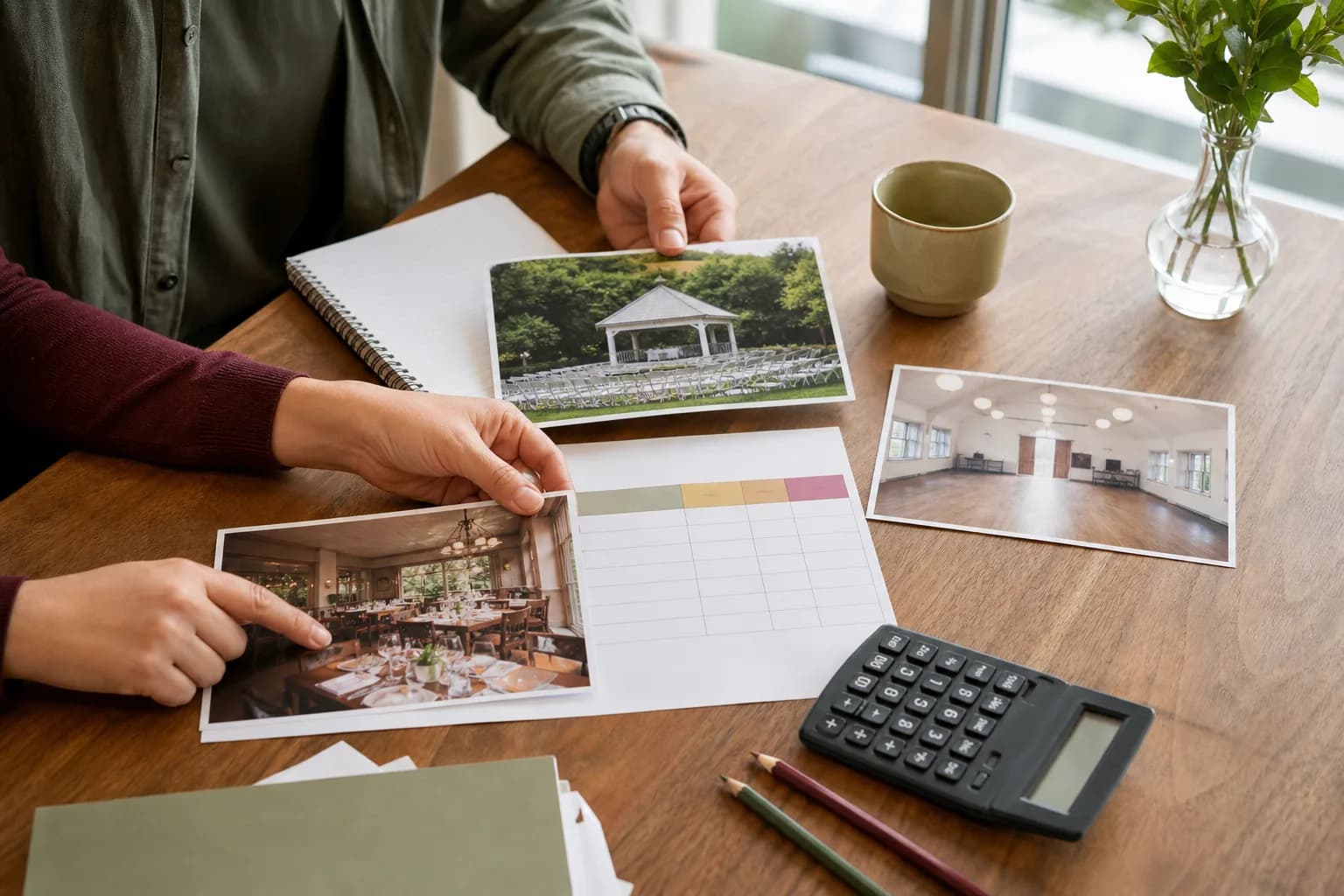
Price the same date, attendance, layout, event hours, food plan, access needs, and rain plan at each. Add permits, required labor, rentals, infrastructure, insurance, parking, taxes, service charges, and travel. Keep refundable deposits apart from expected spending, and mark every required but unpriced item "not yet confirmed" and never enter it as $0.
Types of cheap wedding venues to consider
A national list can’t tell you which venue is cheapest for your wedding. The U.S. Bureau of Economic Analysis measures broad price-level differences among states and metropolitan areas. Those data don’t give wedding quotes, and they don’t work as a multiplier for a particular venue.
Availability, local rules, season, guest count, and the service package also change the result. Use a national article to learn a way to compare, and use current local documents and written proposals to choose the place.
- Public options:
park gardens, gazebos, shelters, recreation rooms, libraries, civic buildings, public museums, and historic facilities that explicitly permit your event type.
- Private or nonprofit options:
restaurant private rooms, association or religious halls open to outside renters, school or alumni spaces, and small venues offering weekday, morning, Sunday, or off-peak dates.
- The tradeoff:
a simple room or flexible vendor policy may lower the space fee while shifting coordination, equipment, compliance, cleanup, and weather planning to you.
How to find real local options
Search the owners of the space before leaning on roundups: "[city] parks wedding permit," "[county] park gazebo rental," "[city] community center wedding rental," "[city] arts center event rental," "[state] state park group facility wedding," and "[city] restaurant private dining minimum spend." Maps, directories, and marketplaces are good for collecting names.
Take each name to the owner’s official page or current rate sheet, because public schedules in Los Angeles County, San Diego County, and Portland separate fees and conditions in different ways.
For each option, write down the source URL, effective date, contact, capacity type, booking window, inclusions, and exactly what is being sold. A ceremony permit doesn’t automatically cover a reception, and an application doesn’t necessarily mean an approved reservation.
Great Smoky Mountains National Park, for example, describes a nonrefundable application fee, capacity and vehicle limits, time that includes setup and cleanup, continued public access at most locations, and possible separate facility reservations. Those rules are specific to that park, and they show how much a low permit line can leave out.
Ask whether the displayed amount is an application, permit, ceremony, reception, hourly room, minimum-spend, or full-day fee.
- Confirm the year or effective date.
If none appears, ask: "Could you send the current rate sheet and rules for our date in writing?"
- Check current availability directly.
A published fee proves neither eligibility nor an open date, and VowMath doesn’t recommend or rank any named facility.
Build one all-in quote before comparing venues
Write one wedding scenario and send it to every venue: exact date and day, ceremony and reception scope, realistic attendance, seated or standing layout, meal and bar format, setup start, guest arrival, event end, cleanup finish, vendor pickup, accessibility needs, travel radius, and outdoor backup. Include regulated features such as alcohol, amplified sound, tents, open flame, or cooking.
A two-hour ceremony permit set beside an eight-hour reception rental makes a neat spreadsheet and a bad decision.
- Space and time:
application, permit, room, ceremony/reception split, minimum hours, setup, deliveries, cleanup, pickup, required staff, security, custodians, and overtime.
- Food and service:
approved or exclusive caterers, minimum spend, kitchen limits, bartenders, bar rules, serviceware, tables, chairs, linens, staging, sound, delivery, and vendor meals.
- Infrastructure and compliance:
power, restrooms, tents, heaters, water, trash, event insurance, liquor-related approvals, fire or tent permits, noise rules, and food-vendor permissions.
- Guest logistics and terms:
parking, entrance fees, shuttles, accessible routes, travel, public access, weather fallback, tax, service charges, payment schedule, cancellation, changes, and damage or cleanup deposits.
Next, work out an expected total and a practical high total. Example numbers, made up for illustration: Option A has a $600 permit, $500 of required staff, a $1,100 furniture quote, a $200 event-insurance quote, and a $900 rain backup. Calculated expected total: $3,300. A separate $500 refundable hold brings venue-side cash due to $3,800.
Option B has a $2,600 indoor rental with furniture, plus $400 of required staff and a $200 insurance quote. Calculated expected total: $3,200, and a $300 refundable hold brings venue-side cash due to $3,500. Under only those assumptions, B costs less even though its headline fee is $2,000 higher.
Keep food, travel, tax, service charges, and other shared scope identical, or price them separately. Then test the conditions that could realistically happen. If A's rain plan or B's overtime is still unquoted, label it "not yet confirmed," name who will get the answer and by when, and hold off on calling either venue affordable.
Leave out upgrades you never asked for, and don’t enter unanswered insurance, security, power, or required-caterer questions as $0. Mark them "not yet confirmed" as well. Treat the result as planning math until each venue sends current written scope for your date.
The extras that most often change a low venue fee
A low base fee can still be a strong value. Find out which work and risk the price leaves with you. Ask the venue to mark every item included, required, optional, prohibited, or still open. Then get third-party quotes for the required items, and have them in hand when you decide on the venue deposit.
- Access time and labor.
Count delivery, setup, decorating, event time, cleanup, and pickup inside the permitted window. Denver’s April 2026 facility regulations give a local example: going past permitted time, including unfinished cleaning, may trigger $200 per hour beginning 15 minutes after the permit end, with a one-hour minimum. That rule applies only to the named Denver facilities.
- Furniture and infrastructure.
Confirm quantities, dimensions, setup responsibility, power, water, restrooms, waste, tent rules, and loading distance. Portland’s brochure, valid for 2026 bookings, says its parks department does not provide chairs or rental equipment and notes limited electricity at some locations, so price chairs and equipment separately from the location fee.
- Catering and bar rules.
Find out whether caterers are open-choice, approved-list, or exclusive; whether cooking is allowed; and which licenses, insurance, bartenders, security, or permissions apply. Montgomery Parks says rental time includes setup and cleanup and describes location-specific catering approval, licensing, insurance, cooking, and electricity rules.
- Insurance and permits.
Ask for coverage limits, additional-insured wording, endorsements, alcohol conditions, and separate permits in writing. The Insurance Information Institute describes cancellation protection and separately lists liability as a possible rider. It tells buyers to ask what is and is not covered and how much reimbursement to expect after a covered loss.
Ask the insurance professional handling the quote what applies: "Which parts of this cover cancellation, and which cover liability?" A venue’s liability requirement doesn’t mean your deposits or cancellation losses are covered.
- Parking, travel, and accessibility.
Walk the route from drop-off or parking to the ceremony, meal, and restroom, including slopes, surfaces, doors, seating, and communication needs. Federal Title II guidance covers access to state and local government programs, including public recreation. A public label alone doesn’t show that one site and every guest’s route through it will work.
- Weather, capacity, and public access.
Price the fallback and ask about exclusivity, closure, and refund terms. At Great Smoky Mountains National Park, the permit includes no services or amenities, most permitted areas stay open to ordinary visitors, vehicles and vendor people count toward limits, and inclement weather does not create a refund.
Treat these as dated conditions for that one park.
What dated public documents show
These examples only show how to read a fee schedule. Each amount and rule comes from one local agency and one dated product. Pull up the current official document and get a written quote for your exact date before relying on it.
Los Angeles County’s schedule effective August 1, 2025 lists indoor space rates separately from kitchen and other event lines, shows some minimum rental periods, and names security or cleanup deposits and potential staff-time charges as their own lines.
San Diego County’s page headed January 2026 Fees likewise lists ceremony and reception areas as different products at some parks, with day-use parking and reservation-related fees elsewhere. Those local structures disprove the shortcut "listed room or ceremony fee equals the reception total," but neither source establishes wedding eligibility, availability, or your final price.
Portland’s brochure for permits booked through 2026 calculates an application charge plus a location usage fee, and separately discusses deposits, insurance, vehicle access, sound, catering, garbage, rentals, and limited amenities. It also gives vehicle-related amounts that differ from one another. Ask the agency which current figure governs.
Your next step
Rule venues out before comparing totals. Cross one off if the actual layout doesn’t work, a guest can’t use essential areas, the permitted window can’t hold delivery through pickup, or the weather plan is missing. Do the same if a required vendor won’t quote until after the deposit, or if the planned alcohol, cooking, sound, tent, power, restroom, parking, or transportation arrangement is prohibited or still open.
Obtain a written quote for the exact scenario, the current rate sheet and rules, and an itemized included/not-included list.
Collect quotes from every required vendor and confirm the seated diagram, guest and vendor capacity, accessibility route, transport plan, and full access schedule.
Price and, when possible, hold the weather option; understand permit and insurance deadlines; and read cancellation, change, deposit-return, damage, and cleanup terms.
Compare expected all-in cost, practical high total, and cash due before the event. Keep every critical unknown visible until confirmed in writing.
Your next step
Shortlist three to five local options, ask each one for the same details, and run their written numbers through the VowMath Reality Check. A kind way to ask: "Could you quote this exact plan in writing and list anything left out of the price?" The lowest compliant total can win even when another venue has a lower base rental.
Frequently asked questions
Are public parks actually cheaper wedding venues?
Sometimes, especially for a simple ceremony, but a park doesn’t automatically cost less. Furniture, restrooms, power, weather coverage, parking, transportation, insurance, permits, and labor can change the comparison. Public use may also continue around the event. Price the same complete wedding at the park and at indoor options before deciding.
Can I have a wedding at a community center?
Possibly, but eligibility and rules vary by building and room. Confirm that private weddings are allowed, then check seated capacity, furniture, staff, kitchen and cooking limits, alcohol, catering approval, insurance, electricity, cleanup, and the exact access window. A room name alone answers none of those questions. Ask for the current rules and a date-specific written quote.
How do I compare an all-inclusive venue with a rental-only venue?
Price both for the same date, guest count, hours, meal and bar format, furniture, serviceware, staffing, transport, compliance, weather solution, taxes, and service charges. Subtract only confirmed inclusions. Compare expected all-in cost and cash due before the event for both.
Is a refundable security deposit part of wedding venue cost?
Put it on its own line, apart from expected cost. It’s cash you need and money at risk, but a returned deposit doesn’t count as final spending. Read the inspection process, withholding reasons, documentation requirements, and refund timing. Montgomery Parks, for example, says security-deposit refunds can take one to six weeks under its local rules.
What should I confirm before paying a venue deposit?
Confirm exact-date availability, the written total and inclusions, every required-vendor quote, layout capacity, accessibility, transport, delivery through cleanup timing, permit and insurance duties, weather fallback, payment schedule, and cancellation or change terms. If a required material cost is still unknown, hold off on calling the venue affordable.
Last reviewed . Editorial standards