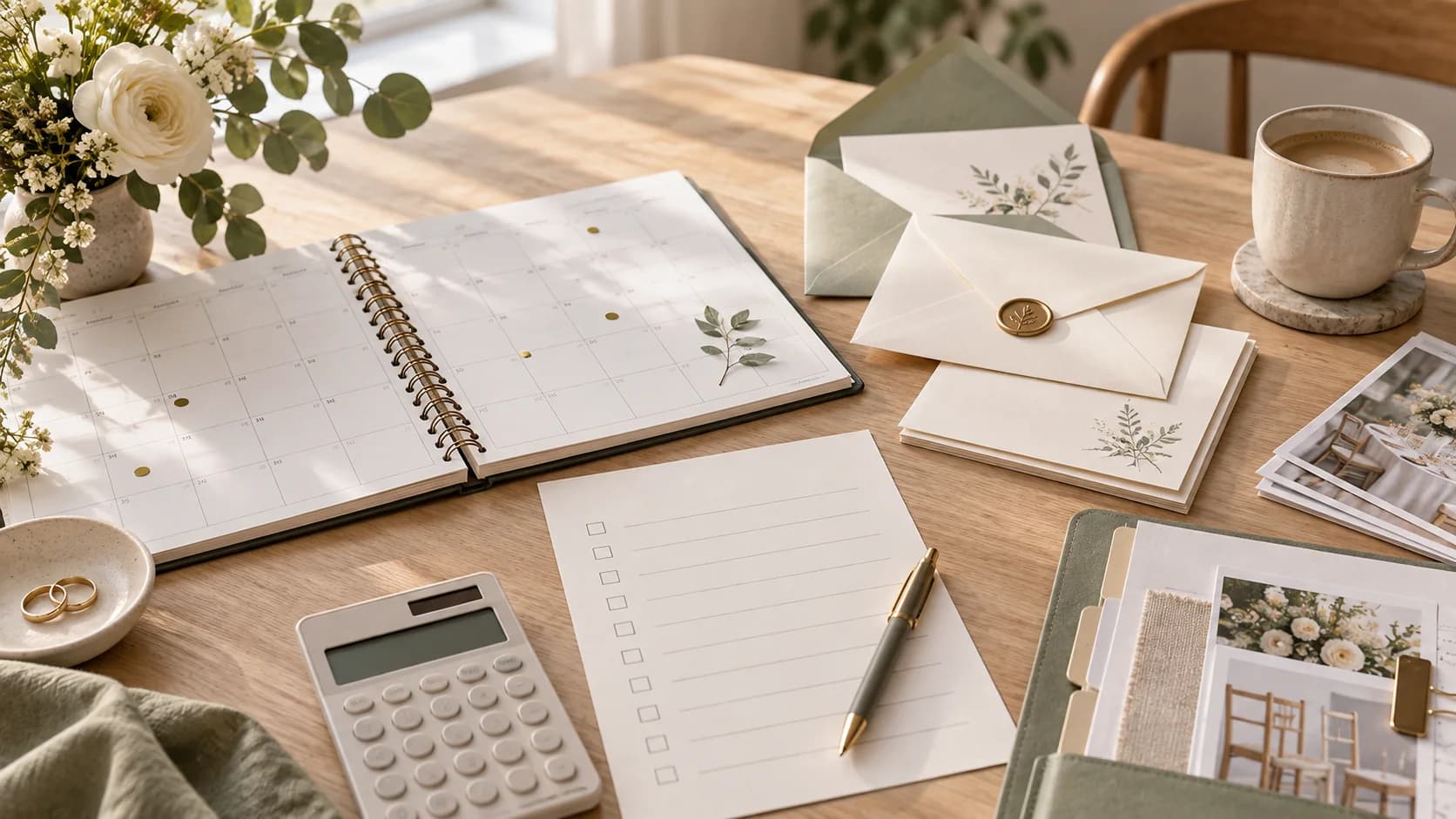
Mark each item confirmed, waiting for a reply, or still open. Keep a confirmed-cost subtotal and list unknown costs separately until the provider or local office gives the missing term.
Start with the guest list and decisions that control other decisions
Zola's retained checklist groups wedding work around the budget, venue, vendors, guest information, and day-of logistics. Use that map to build a list for your event, then put the event date at the top and record each decision that affects later work.
A venue choice can change guest capacity, payment dates, mailing address, and vendor access. A guest-count change can change food, room, and invitation work, so give each decision its own line and keep its proof beside it.
Write the event date, location, guest-count target, and budget ceiling.
Mark each task confirmed, waiting for a reply, or still open.
Record the owner, next action, and date for every unfinished task.
Keep a link to the exact proposal, agreement, email, or local-office page beside the task.
| Task | Record | Status |
|---|---|---|
| Date and guest count | Event date, guest target, and location | Choose: open / waiting / done |
| Venue | Access, payment dates, cutoff, and current agreement | Choose status |
| Ceremony | Officiant, ceremony time, rehearsal, and sound | Choose status |
| Attire | Outfits, fittings, alterations, and pickup | Choose status |
| Food and catering | Menu, guest count, service, rentals, and fees | Choose status |
| Photography and music | Hours, locations, deliverables, and access | Choose status |
| Transport and lodging | Routes, arrival times, rooms, and contact person | Choose status |
| Seating and final counts | Table plan, replies, meals, and accessibility needs | Choose status |
| Vendors and payments | Scope, deposit, balance, and schedule | Choose status |
| Legal documents | Local office link and required documents | Choose status |
| Invitations | Proof date, address check, mailing service, and reply date | Choose status |
| Final handoff | Current schedule and person for each open task | Choose review date |
Use the sequence below as an adaptable example tied to your venue contract, vendor lead times, reply date, and local-office instructions. Combine stages when your event is close, and use an earlier contract deadline when one applies.
The sequence shows how decisions can depend on each other. It gives you a place to start while you set dates for your own event.
| Stage | Tasks to place on your list | Dependency |
|---|---|---|
| Set the plan | Date, location, guest target, budget, and priority decisions | Use the event date and venue options |
| Book the anchors | Venue, ceremony lead, catering, photography, music, and attire | Read the written terms and payment dates |
| Build the guest record | Address list, lodging, transport, seating approach, and accessibility | Update when replies or venue limits change |
| Send and confirm | Invitation proof, mailing service, reply date, menu count, and vendor schedule | Follow local and contract deadlines |
| Run the handoff | Final count, table plan, contacts, payments, access, rehearsal, and day-of schedule | Review open answers before the final week |
Separate local legal tasks from the general checklist
Add legal-document work when you know the state or territory. USAGov directs readers to the relevant state or territory office for marriage-license and marriage-certificate instructions, so the local office should supply the current fee, waiting period, appointment rule, and document list.
Copy the local office link into your record, add the date you checked it, and list every required item. Assign an owner and next action, then review the task when the office changes its instructions.
| Task | Record | Status |
|---|---|---|
| Marriage-license instructions | State or territory office URL and check date | Still open |
| Documents | Names of required identity or prior-record documents | Waiting for local list |
| Timing | Application, ceremony, and certificate dates | Check local rule |
| Owner | Person responsible for the next call or appointment | Add a date |
Keep vendor promises, payments, and changes together
Keep each vendor promise and payment in the same record. The Federal Trade Commission gives general advice to save purchase documents and notes from problem-solving conversations, including dates and promises. Use that recordkeeping habit for proposals, signed agreements, invoices, payment confirmations, schedule changes, and messages that change the work.
These records make it easier to resolve a memory gap or compare the current terms. They are general recordkeeping support, so ask a qualified local professional about contract, cancellation, or refund questions. Put the current version at the top of the folder and move old versions into an archive.
Record the deposit amount, due date, payment method, and balance.
Save each approved change with the date and the person who accepted it.
List access, setup, teardown, travel, overtime, and required fees as separate lines.
- Ask the vendor:
"Please confirm the deposit, balance, access, overtime, cancellation, and substitution terms for our date."
Compare the current record with the schedule before the final payment.
Give invitations a proofing and mailing plan
Emily Post's invitation page tells guests to reply promptly, follow the stated method, and use the RSVP deadline when one appears. Add those reply details to your planning record.
USPS describes domestic mailing services with service-specific commitments. Choose a service after you know the address list, proofing date, and date when replies are useful, then check current terms for the address.
Use the proofed wording, address list, return address, postage choice, and mailing date as one record. A checklist date alone cannot guarantee arrival; service, address, and current conditions matter.
Proof names, dates, venue details, reply instructions, and return addresses.
Check addresses and mark the date when the list was last checked.
- Ask the stationer or printer:
"Please confirm the proof date, reprint policy, address changes, postage choice, and mailing date."
Choose the USPS service after you define the mailing need and timing.
Keep a small reserve for reprints, address corrections, or replacement postage.
Run a final checklist review
Before the final week, read the checklist as if a new person must use it. That person should find the confirmed items, due dates, owners, next actions, and missing answers without relying on a private planning conversation.
Save proof before you remove a completed task. Keep the live schedule beside the vendor folder, guest list, and local legal-office link, and review dependent tasks when the date, location, guest count, or budget changes.
A checklist works when it makes the next decision clear. It can stay flexible while still showing the next action for every open item.
Your next step
Create one dated list today. Add the event date, guest count, location, budget ceiling, local legal-office link, vendor payment dates, invitation proofing date, and one next action for each open item. Then mark each line confirmed, waiting for a reply, or still open.
Frequently asked questions
What should a wedding planning checklist include?
Start with the event date, guest count, budget ceiling, and location. Then list the decisions that affect other decisions, such as the venue, guest list, and legal documents. Zola's checklist is a planning reference. Adjust the order to your date and local requirements.
When should I check marriage-license rules?
Add a legal-document task that points to the state or territory office for your event. USAGov explains that marriage-license and certificate instructions come from the relevant state or territory. Use the local office's current instructions for the date, fee, waiting period, and document list.
Which wedding planning records should I save?
Keep the proposal, signed agreement, invoices, payment records, schedule, and written changes together. The FTC gives general guidance for keeping records when you resolve a business problem. Ask a qualified local professional about contract or refund questions.
How do I plan invitation mailing?
Choose the mailing service after you know the address list, proofing date, and date by which replies are useful. USPS describes different services and commitments, including service-specific terms that need a current check. Emily Post's RSVP guidance can help you record the reply method and deadline. Use the local address and current service terms to make the final choice.
Last reviewed . Editorial standards